Description
Incomplete Records
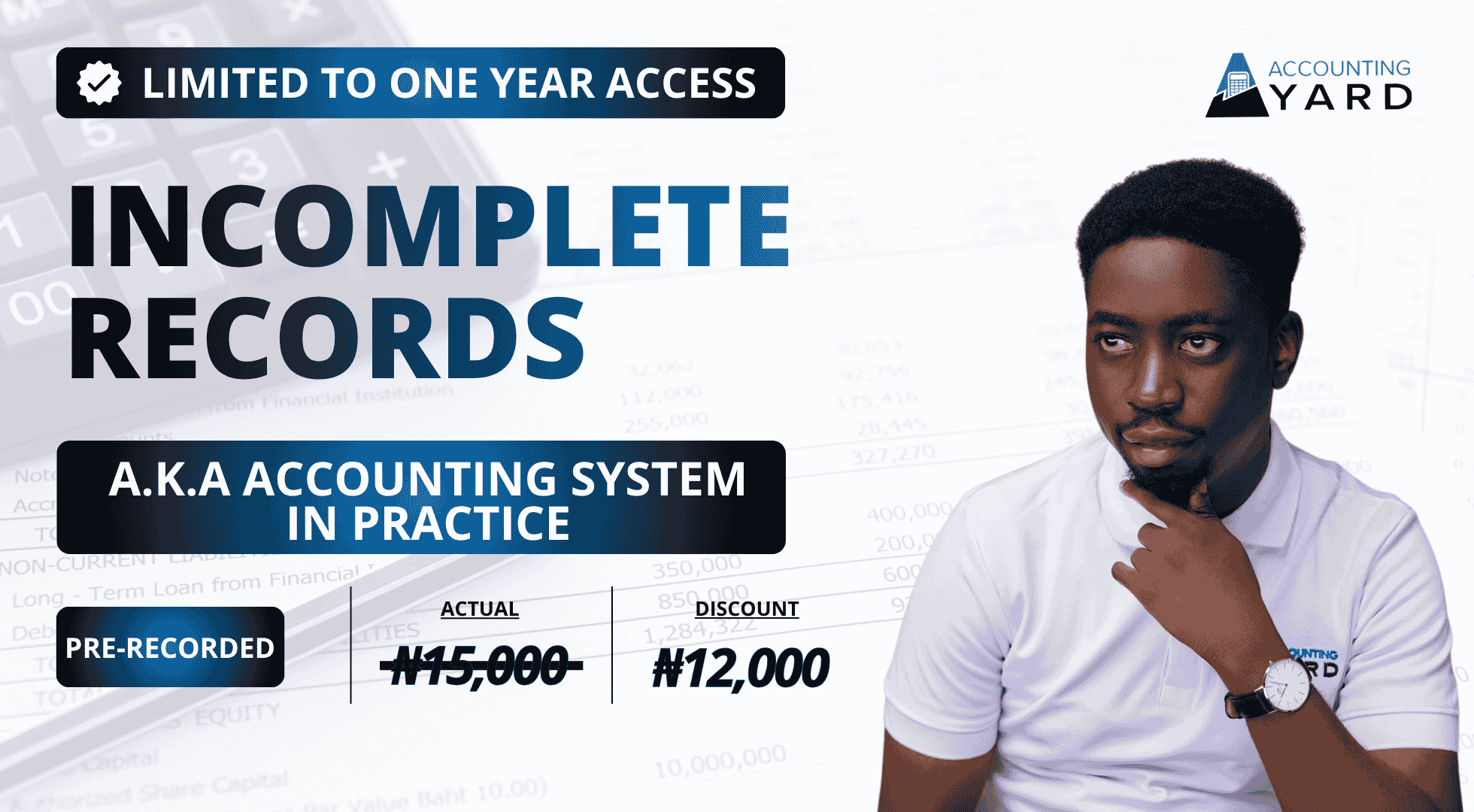
Turn a bank statement and scattered records into a complete general ledger and a balanced trial balance.
This course starts with accounting-system foundations (the accounting cycle, chart of accounts, double entry, inventory costing and GL extraction), then reconstructs the books of a case-study business, EJ Perfume, from incomplete records. You use AI tools (Gemini and Claude) and manual Excel analysis to classify the bank statement, then build schedules for payroll, prepayments, fixed assets, inventory and loan interest through to a final trial balance. It is taught through recorded live classes with Q&A, demos and the practical files used in class.
What you will be able to do
✓Explain the accounting cycle and core concepts, including how financial statements differ from management accounts and how a chart of accounts and double entry work.
✓Record early-stage transactions such as incorporation costs, inventory purchases, VAT on purchases, sales and vendor payments, and cost inventory using FIFO or weighted average.
✓Analyse a bank statement with AI and by hand, writing context-rich prompts for Claude, reviewing the output and classifying bank charges, inflows and expenses in Excel.
✓Build the general ledger from the analysed statement, applying a year-end cut-off, correcting classification errors and preparing the opening trial balance.
✓Prepare year-end schedules: a fixed asset register with depreciation, a payroll schedule from net to gross pay, rent prepayments, accruals, inventory rollback and accrued interest.
✓Produce a final trial balance after posting all adjustments and correcting the errors identified.
Your learning journey
1Accounting Foundations(Modules 1–2)
Learn the accounting cycle, FS vs management accounting, the chart of accounts and double entry.
2Transactions, Inventory and the GL(Modules 3–4)
Record incorporation, purchases, VAT and sales, cost inventory and extract a GL with a pivot table.
3Incomplete Records and AI Analysis(Modules 5–7)
Apply the 5-step framework, research the business with AI and classify the bank statement with Claude and in Excel.
4Ledger, Fixed Assets and Schedules(Modules 8–9)
Build the GL and fixed asset register, then payroll, prepayment, accrual and inventory schedules.
5Final Trial Balance(Module 10)
Post interest, depreciation, payroll and inventory adjustments and finalise the trial balance.
6Final Assessment and Certificate(Module 11)
Complete the study assessment and final test, then earn your certificate.
What you get
139 video lessons (about 35 hours) recorded from live classes, with real participant questions answered
EJ Perfume case-study files: the Access Bank statement in raw, analysed, V5 and final versions, the information and data pack, and the schedules for EJ Perfume, so you can follow each stage of the reconstruction.
Working schedules and guides: Fixed Asset Register, payroll calculation, prepayment, loan computation, inventory schedule and valuation, FIFO vs WAVCO, IAS 2 work paper and double-entry templates, plus the Bank Statement Analysis AI Guide, AI Research Prompt Guide and course handout.
10 module quizzes and a final assessment to check your understanding
12 months of access to learn at your own pace and revisit any lesson
An Accounting Yard certificate when you complete the lessons and pass the quizzes
Who this course is for
Before you start: you should know basic bookkeeping terms (debits, credits, assets and expenses) and be comfortable using Excel for everyday tasks.
Try it before you buy
The first four lessons in Module 1 are free to watch.
Reviews
There are no reviews yet.