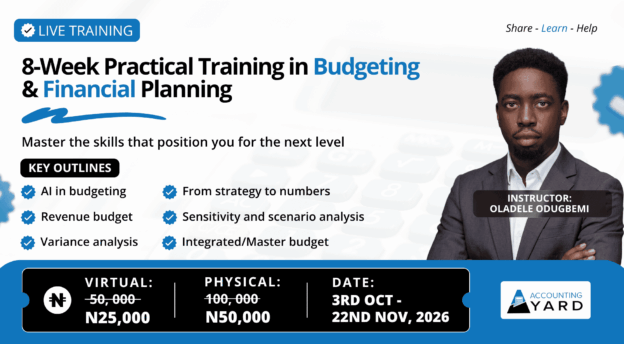
Budgeting and Financial Planning 2026
About Course
Budgeting and Financial Planning 2026
Turn strategy into a budget the business can actually run on.
Recorded live training that takes you from the strategic plan and annual operating plan to a fully linked budget: assumptions, revenue and cost of sales models, CapEx, finance cost, tax, and the budgeted income statement, statement of financial position and cash flow statement.
What you will be able to do
✓Connect strategy to numbers: link the strategic plan, annual operating plan (AOP) and budget.
✓Choose the right budgeting approach for the business, from incremental and zero-based to rolling budgets.
✓Run the practical budgeting cycle and avoid the reasons budgets fail before the year starts.
✓Develop and classify budget assumptions that managers own and reviewers can test.
✓Build the revenue and cost of sales budgets step by step in a driver-based model.
✓Budget CapEx, depreciation, finance cost, borrowings and tax, and link everything into the budgeted income statement, statement of financial position and cash flow statement.
Your learning journey
1Foundations (Module 1)
From strategy to numbers: strategic plan, AOP and budget.
2Approaches and the budgeting cycle (Modules 2–3)
Budgeting approaches, the practical cycle and building solid assumptions.
3Case study (Module 4)
Review quizzes and a worked case study walkthrough.
4Revenue and cost of sales (Modules 5–6)
Build the budget model, revenue model, cost of sales and departmental budgets.
5Financial position and cash flow (Modules 7–8)
CapEx, finance cost, PPE, inventories, borrowings, tax and the budgeted cash flow statement.
6Final assessment and certificate (Module 9)
A 20-question final assessment. Score 80% to earn your certificate.
What you get
69 video lessons, about 22 hours of recorded live training, including the class Q&A sessions
8 module quizzes (10 questions each) and a 20-question final assessment
Accounting Yard certificate of completion
12 months of access
Who this course is for
Try it before you buy
The first four lessons are free to watch: 1.1 Welcome: Course Introduction and Expectations, 1.2 Course Itinerary: What We Will Cover Day by Day, 1.3 Q&A: Course Logistics and Expectations, 1.4 Preamble: Why Budgeting Still Matters in 2026.
Course Content
Module 1: From Strategy to Numbers: Budgeting Foundations
-
24:17
-
10:42
-
06:28
-
12:05
-
1.5 From Strategy to Numbers
22:36 -
1.6 Q&A: Turning Strategy into Numbers
40:02 -
1.7 Strategic Plan, Annual Operating Plan (AOP) and Budget
18:07 -
1.8 Q&A: Strategic Plan, AOP and Budget
24:19 -
1.9 Q&A Continued: Strategic Plan, AOP and Budget
03:23 -
1.10 Quiz Review: Budgeting Foundations
13:05 -
1.11 Q&A After Class: Day 1 Open Questions
17:24 -
Module 1 Quiz: Budgeting Foundations
Module 2: Budgeting Approaches and When to Use Each
Module 3: The Practical Budgeting Cycle and Budget Assumptions
Module 4: Review Quizzes and Case Study Walkthrough
Module 5: Building the Budget Model and Revenue Model
Module 6: Cost of Sales and Departmental Budgets
Module 7: CapEx, Finance Cost and the Budgeted Financial Position
Module 8: Borrowings, Tax and the Budgeted Cash Flow Statement
Module 9: Final Assessment and Certification
Student Ratings & Reviews
